



Was wir tun
Unsere Kompetenzfelder umfassen das komplette Leistungsspektrum von der Nachhaltigkeitsstrategieberatung und Implementierung über das Management bis zur Kommunikation.
Nutzen Sie Nachhaltigkeit und ESG als Wettbewerbsvorteil, indem Sie Ihre eigenen Möglichkeiten im Bereich der Nachhaltigkeit aufdecken, Ihre Glaubwürdigkeit erhöhen, Risiken minimieren und Kostensenkungspotentiale nutzen. So schaffen Sie Win–win–Situationen, durch die gleichermaßen Unternehmen, Gesellschaft und Umwelt profitieren.
Wir befähigen Sie zu mehr Nachhaltigkeit in Ihrem Unternehmen. Durch unseren Beitrag bleiben Sie auch in Zukunft stark.
Unsere Leistungen im Überblick

Strategie
- Wesentlichkeitsanalyse
- Nachhaltigkeitsstrategie
- Ziele und Indikatoren (KPIs)
ESG Rating Advisory (z. B. ISS-ESG, MSCI, Sustainalytics, S&P Global, EcoVadis)
- EU-Taxonomie
Klimabilanzierung und Klimastrategie
(CDP, SBT, TCFD)- Marktanalysen und Benchmarking
- Wirkungsmessung und Controlling

Management
- Nachhaltigkeitsmanagement
- Begleitung von Transformationsprozessen
- Executive-Coaching zu Nachhaltigkeit
- Training und Kompetenzentwicklung
- Datenmanagement und Datensoftware

Kommunikation
Nachhaltigkeitsreporting, Online Reporting und Integrated Reporting (GRI, DNK, CSRD, ISSB, SFDR, VSME)
- Erklärungen zum Deutschen Nachhaltigkeitskodex (DNK)
- Umwelterklärungen (EMAS)
- Stakeholder-Beteiligung und -Dialoge
- Interaktive Veranstaltungsformate
Im Fokus
Mit Klick auf einen der Begriffe erfahren Sie mehr über das Thema und was wir Ihnen in diesem Bereich anbieten.
Unsere Leistungen zur CSRD für Sie
Fällt Ihr Unternehmen unter die Corporate Sustainability Reporting Directive (CSRD)? Dies ist für große kapitalmarktorientierte Unternehmen ab Berichtsjahr 2024 der Fall. Unternehmen, die unter die Richtlinie fallen, müssen künftig in ihrem Lagebericht umfangreiche Angaben zur Nachhaltigkeit machen.
:response unterstützt Sie bei der optimalen Vorbereitung auf die Berichtspflicht – von der CSRD-konformen Wesentlichkeitsanalyse über die Ausrichtung von Nachhaltigkeitsstrategie, Prozessen und Datenmanagement auf die CSRD-Anforderungen bis zur Erstellung des Berichts.
Was ist die CSRD?
Die EU Corporate Sustainability Reporting Directive (CSRD) löst die bisherige nicht-finanzielle Berichterstattungspflicht (EU Non-Financial Reporting Directive, NFRD) ab. Die EU verfolgt damit das Ziel, die Nachhaltigkeitsberichterstattung der Finanzberichterstattung gleichzustellen.
Zentraler Teil der CSRD sind einheitliche EU-Standards für die Nachhaltigkeitsberichterstattung, die sogenannten European Sustainability Reporting Standards (ESRS). Unternehmen, die gemäß CSRD zur Nachhaltigkeitsberichterstattung verpflichtet sind, müssen diese verbindlichen europäischen Standards anwenden. Die Standards fordern Angaben zu Umwelt, Soziales und Governance – zu den Auswirkungen auf Nachhaltigkeit, zu Nachhaltigkeitsrisiken und -chancen für die Geschäftstätigkeit sowie zu Zielen, Prozessen und Maßnahmen, um dem entgegenzuwirken. Zu diesen qualitativen Angaben kommen Kennzahlen, unter anderem aus den Bereichen Klima, natürliche Ressourcen und Personal.
Wer ist von der CSRD betroffen?
Die Berichtserstattung gemäß CSRD wird seit dem Berichtsjahr 2024 für große kapitalmarktorientierte* und ab 2028 für alle großen Unternehmen verpflichtend. Als groß sind alle Unternehmen definiert, die zwei der folgenden Kriterien erfüllen:
(1) mehr als 1.000 Mitarbeitende
(2) Umsatz von mehr als 450 Millionen Euro
Kleinere und mittlere börsennotierte Unternehmen werden in den nachfolgenden Jahren in den Anwendungsbereich fallen. Die Nachhaltigkeitsberichterstattung wird mit der CSRD zu einem verpflichtenden Teil des Lageberichts und muss in elektronischer Form veröffentlicht werden (Single Electronic Reporting Format). Die Inhalte des Nachhaltigkeitsberichts müssen zudem einer externen Prüfung mit begrenzter Sicherheit unterzogen werden.
Aufgrund der umfangreichen Anforderungen aus den European Sustainability Reporting Standards empfehlen wir, sich frühzeitig auf die Berichtspflicht vorzubereiten. Dabei stehen wir Ihnen gern zur Seite.
*alle kapitalmarktorientierten Unternehmen mit mehr als 500 Mitarbeitern sowie mehr als 25 Millionen Euro Bilanzsumme oder 50 Millionen Euro Umsatz
Unsere Leistungen zur CSRD für Sie:
- Gap Analyse: Abgleich bestehenden Nachhaltigkeitsstrategie, des Datenhaushalts und der Berichtsprozesse mit CSRD-/ESRS-Anforderungen
- Roadmap zur zur schrittweisen Umsetzung der Anforderungen aus CSRD/ESRS
- Erstellung einer Wesentlichkeitsanalyse gemäß CSRD nach Prinzip der doppelten Wesentlichkeit
- Analyse von Nachhaltigkeitsrisiken
- Beratende Unterstützung bei der Einführung und Weiterentwicklung von Strategien und Prozessen für das Nachhaltigkeitsmanagement
- Bestimmung der nach CSRD zu erhebenden qualitativen Angaben und Kennzahlen sowie Beratung bei der Datenerhebung und dem Aufbau eines Datenmanagements
- Konzeption und Erstellung eines Nachhaltigkeitsberichts bzw. Kapitel des Lageberichts
Die doppelte Wesentlichkeit
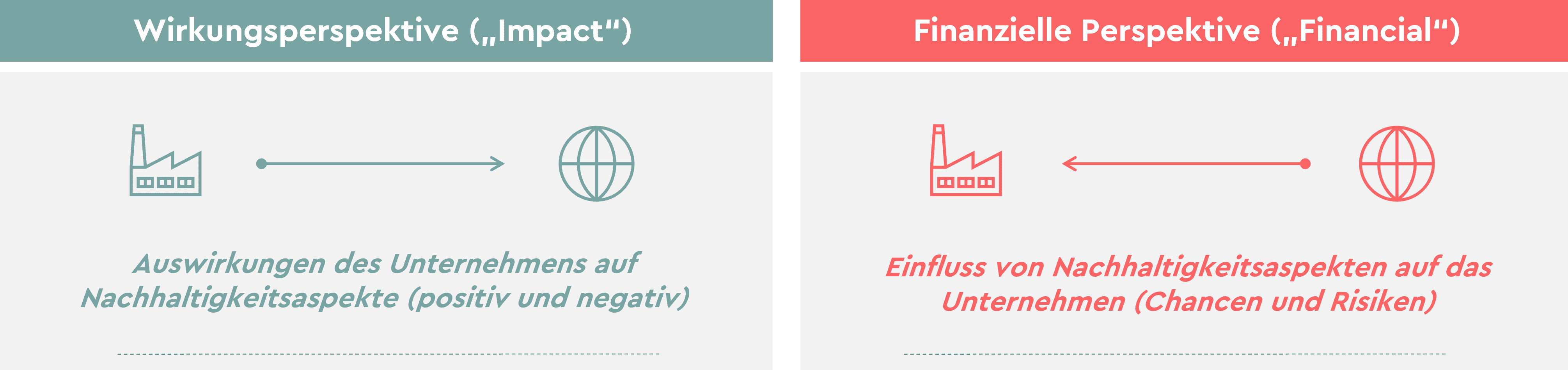
Unsere Leistungen zur EU-Taxonomie für Sie
Ist Ihr Unternehmen bereits jetzt von der EU-Taxonomie betroffen? Oder betrifft Sie die Verordnung zu einem späteren Zeitpunkt?
:response begleitet Sie durch den gesamten Umsetzungsprozess zur Erfüllung der EU-Taxonomie, von der Prüfung auf Taxonomiefähigkeit bis zur Erfüllung der gesetzlichen Berichtspflichten Ihres Unternehmens.
Was ist die EU-Taxonomie?
Die EU-Taxonomie ist ein System zur Klassifikation nachhaltiger Wirtschaftsaktivitäten. Sie ist das Kernstück des EU-Aktionsplans zur Finanzierung nachhaltigen Wachstums. Mit der Taxonomie möchte die EU mehr Transparenz und ein einheitliches Verständnis über nachhaltige Wirtschaftsaktivitäten schaffen. Gemäß der Verordnung müssen Unternehmen und Finanzinstitute darüber berichten, welche ihrer Geschäftsaktivitäten ökologisch nachhaltig sind.
Als taxonomiekonform und damit nachhaltig gemäß der EU-Taxnonomie gelten Wirtschaftsaktivitäten, die …
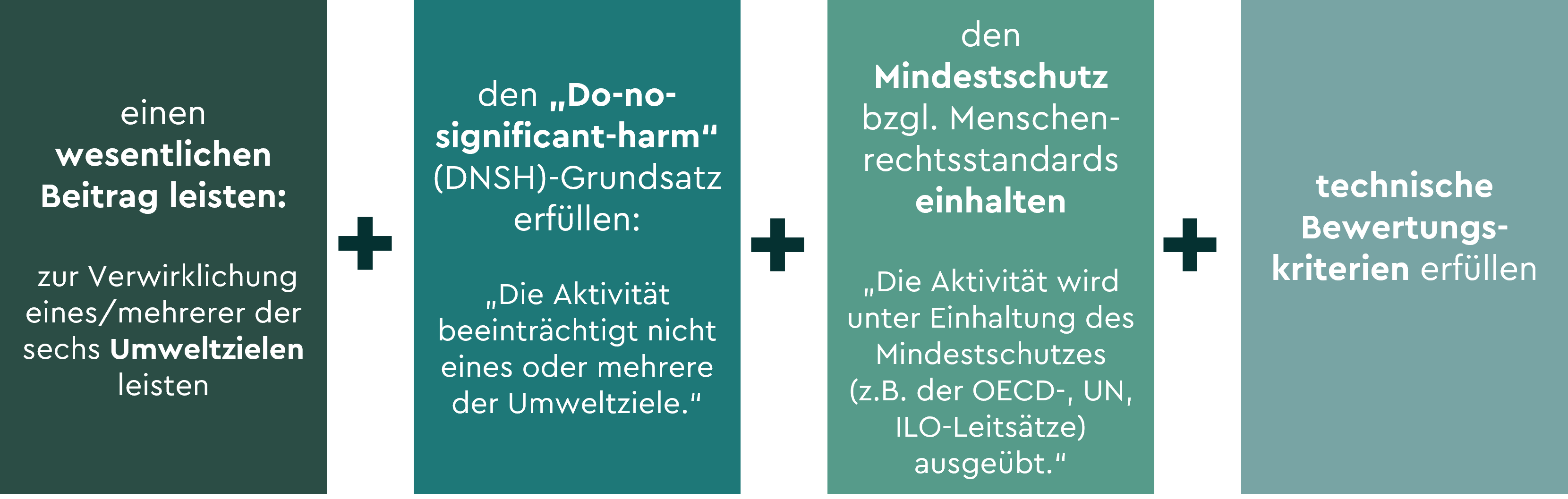
Ab 2024 müssen alle betroffenen Unternehmen die vollständigen Offenlegungsanforderungen der EU-Taxonomie für die sechs Umweltziele erfüllen.

Wer ist von der EU-Taxonomie betroffen?
Unternehmen in Deutschland, die zum Anwenderkreis der EU Non-Financial Reporting Directive (NFRD) gehören, müssen bereits jetzt gemäß EU-Taxonomie berichten. In Deutschland ist die NFRD durch das CSR-RUG umgesetzt. Für alle anderen großen Unternehmen wird die Taxonomie relevant, sobald die Corporate Sustainability Reporting Directive für sie in Kraft tritt. Das heißt:
Für wen gilt die Taxonomie?
1. Finanzmarktteilnehmer, die Finanzprodukte bereitstellen
2. Unternehmen, die zur Veröffentlichung nichtfinanzieller Erklärungen verpflichtet sind (NFRD), diese fallen ab dem Berichtsjahr 2024 unter die Corporate Sustainability Reporting Directive (CSRD)
3. Perspektivisch für alle Unternehmen, die unter die CSRD fallen
(ab 2026 für das Berichtsjahr 2025 für Unternehmen mit mehr als 250 Mitarbeitenden, Bilanzsumme über 25 Millionen Euro oder Umsatzerlösen über 50 Millionen Euro*, ab 2027 für das Berichtsjahr 2026 für börsennotierte KMU, kleine und nicht komplexe Kreditinstitute und firmeneigene Versicherungsunternehmen)
Unsere Leistungen zur EU-Taxonomie für Sie:
- Vorbereitung auf die schrittweise Umsetzung der Taxonomie
- Entwicklung eines effizienten Vorgehens für die Taxonomie-Prüfung
- Prüfung auf Taxonomie-Fähigkeit
- Prüfung auf Taxonomie-Konformität
- Integration in den Datenhaushalt und die Prozesse Ihres Unternehmens
- Unterstützung bei der Erhebung der Taxonomie-Quoten (Taxonomie KPIs, Green Asset Ratio)
Unsere Leistungen zum ESG-Rating-Advisory für Sie
:response begleitet Sie auf dem Weg zu einem überzeugenden ESG-Rating, mit dem Sie das Vertrauen Ihrer Investoren und des Kapitalmarkts in Ihr Unternehmen erhöhen. Wir stehen Ihnen während des gesamten Ratingprozesses zur Seite und unterstützen Sie, Ihr ESG-Rating zu verbessern.
Warum ESG-Ratings?
Investoren, Kunden und NGOs fordern eine immer transparentere Berichterstattung zu Ihrem ökologischen und sozialen Beitrag. Ein gutes ESG-Rating verbessert deshalb nicht nur die Reputation Ihres Unternehmens, sondern kann auch den Zugang zum Kapitalmarkt erleichtern, Investoren anziehen und Finanzierungen ermöglichen.
ESG-Ratings entwickeln sich zu den wichtigsten Indikatoren für Ihren Erfolg in Sachen Nachhaltigkeit. Das wissen auch Ihre Investoren, Wettbewerber und Kunden.
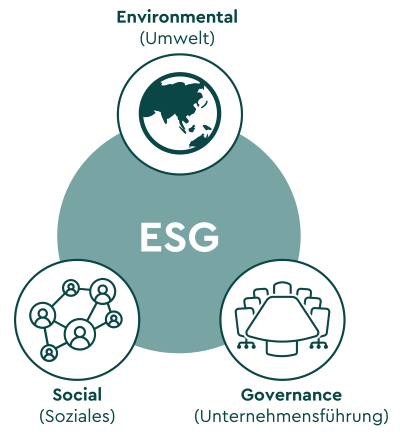
Unsere Leistungen im ESG-Rating-Advisory für Sie:
- Analyse Ihres ESG-Ratings auf Optimierungspotenziale
- Aufbau eines ESG-Datenmanagements zur gezielten Bereitstellung ratingrelevanter Daten
- Ausrichtung der Berichtsinhalte an den Bewertungskriterien der ESG-Ratings
- Beratung zu den für Sie am besten geeigneten Ratings (z. B. ISS-ESG, MSCI, Sustainalytics, S&P Global, EcoVadis…)
- Operative Unterstützung im Ratingprozess
- Insgesamt: Steigerung Ihrer Nachhaltigkeitsperformance und zielgerichtete Kommunikation für ESG-Ratings
Unsere Leistungen zur SFDR für Sie
Ist Ihr Finanzunternehmen von der europäischen Sustainable Finance Disclosure Regulation (SFDR) betroffen und muss seine Nachhaltigkeit auf Unternehmens- und Produktebene offenlegen?
:response unterstützt Sie während des gesamten Offenlegungsprozesses nach der SFDR und bei dessen Ausweitung auf die Offenlegung von Principal Adverse Impacts (PAIs).
Was ist die SFDR?
Bei der SFDR handelt es sich um eine europäische Verordnung, mit der die EU die Transparenz im Markt für nachhaltige Investmentprodukte schärfen und somit Greenwashing verhindern möchte. Die Verordnung setzt ein Kernanliegen des EU-Aktionsplans zu Sustainable Finance von 2018 um. Mit der SFDR müssen Finanzakteure erstmals umfängliche Informationen zu ESG-Metriken und -Risiken sowohl auf der Unternehmens- als auch Produktebene offenlegen. Diese Transparenz soll Anlegerinnen und Anlegern essenzielle Informationen liefern, um nachhaltigere Investitionsentscheidungen zu treffen und somit Finanzströme in die nachhaltige Transformation zu lenken.
Wer ist von der SFDR betroffen?
Für wen gilt sie?
1. Finanzberater (Financial advisors)
2. Finanzmarktteilnehmer (Financial market participants)
Offenzulegen sind:
Nachhaltigkeitsrisiken
aus den Bereichen: Umwelt, Soziales, Governance, die Anlagen beeinträchtigen könnten
Offenlegung, ob nachhaltige Investitionen mit DNSH-Prinzip übereinstimmen
Die wichtigsten negative Auswirkungen auf Unternehmens- und Produktebene: Principle Adverse Impacts (PAI) ab Januar 2023
- Nachteilige Auswirkungen von Investitionsentscheidungen auf Umwelt-, Sozial-, Arbeitnehmer- und Menschenrechtsbelange
- Maßnahmen zur Behebung nachteiliger Auswirkungen

Unsere Leistungen zur SFDR für Sie:
- Entwicklung eines Sustainable Investment Frameworks
- Analyse von Nachhaltigkeitsrisiken
- Analyse der wichtigsten negativen Auswirkungen auf Unternehmens- und Produktebene und Offenlegung anhand von Kennzahlen (PAIs)
- Analyse der Portfoliobeschaffenheit nach SFDR-Kriterien
- Beratung zur Entwicklung von SFDR Artikel 8 ESG-Fonds
- Beratung zur Entwicklung von SFDR Artikel 9 Impact-Fonds

Unsere Leistungen im Bereich Klima für Sie
:response bietet Ihnen Orientierung und Fokus auf das Wesentliche:
Wir arbeiten mit etablierten Standards wie dem Greenhouse Gas Protocol für die Treibhausgasbilanzierung (THG-Bilanzierung) und der Science Based Targets Initiative für die Formulierung von wissenschaftlichen Zielen (SBT). Gemeinsam mit den relevanten Unternehmensbereichen und Anspruchsgruppen entwickeln wir eine überzeugende Strategie, die verstanden und gelebt wird.
Warum Klimabilanzierung und -strategie?
Klimaschutz ist eines der zentralen und gleichzeitig komplexen Themen unserer Zeit. Eine vollständige THG-Bilanz und eine Klimastrategie helfen dabei, belastbare Klimainformationen zu ermitteln, Ihre Auswirkungen auf das Klima zu steuern und Ihre Erfolge zu kommunizieren. Warum sollte Ihr Unternehmen sich mit seinen Auswirkungen auf das Klima befassen?
- Beitrag zur Erreichung des 1,5 Grad-Ziels des Pariser Klimaschutzabkommens (pariskompatible Strategie)
- Reduktion der mit dem Klimawandel verbundenen Risiken
- Erfüllung der zunehmenden rechtlichen Anforderungen im Bereich THG-Bilanzierung und Klimaschutz, beispielsweise durch die CSRD und die Taxonomie
- Vermeidung von Reputationsrisiken und Greenwashing
- Stärkung Ihrer Wettbewerbsfähigkeit
Unsere Leistungen im Bereich Klima für Sie:
- THG-Bilanz: Wir begleiten Sie bei der Datenerhebung und ermitteln den CO2-Fußabdruck Ihres Unternehmens („Corporate Carbon Footprint“) nach dem Standard des Greenhouse Gas Protocol (Scope 1 bis 3).
- Klimastrategie: Wir formulieren auf Ihr Unternehmen zugeschnittene (wissenschaftsbasierte) Ziele und entwickeln Maßnahmen, um diese zu erreichen. Durch die Berechnung der CO2-Vermeidungskosten unterstützen wir Sie, die wirksamsten und effizientesten Maßnahmen zu wählen.
- Science Based Targets (SBT): Wir führen Sie durch den komplexen Prozess der Definition und Einreichung von wissenschaftsbasierten Zielen (SBT).
- Kompensation: Für nicht-vermeidbare THG-Emissionen erarbeiten wir mit Ihnen eine Kompensationsstrategie und wählen die für Sie passenden Projekte für die CO2-Kompensation aus, die wirklich positiv auf das Klima wirken und höchsten Standards genügen.
- TCFD: Wir unterstützen Sie beim Datentool-basierten Climate Risk Assessment (Identifikation und Bewertung von klimabezogenen Chancen, physischen und transitorischen Risiken), führen die Szenarioanalyse durch und beraten Sie beim TCFD-Reporting.
- Reporting: Wir begleiten Sie bei der Kommunikation Ihres Klimaengagements in Form eines Klima- und/oder Nachhaltigkeitsberichts, inklusive inhaltlicher Konzeption, Redaktion und Gestaltung. Als CDP Accredited Solutions Provider begleiten wir sie außerdem bei der Offenlegung Ihrer Umweltdaten nach CDP.
Unsere Leistungen im Bereich ESG-Training für Sie
Die Nachhaltigkeitsreise von Unternehmen führt über verschiedene Etappen. Wenn größere Veränderungen anstehen, ist es wichtig, das Ziel und den Weg dorthin zu kennen und möglichst viele Mitarbeitende für die kommenden Herausforderungen bereit und fit zu machen.
Wer sich auskennt, kann sich einbringen und Teil der Lösung sein. Denn unternehmerische Nachhaltigkeit stiftet für viele Mitarbeitende Sinn. Darin steckt großes Potenzial.
Für die effiziente Umsetzung von Nachhaltigkeitsprojekten ist neben Sensibilisierung auch Fachwissen gefragt – nicht nur in der Nachhaltigkeitsabteilung, sondern auch in vielen weiteren Arbeitsbereichen. Dies legt den Grundstein, um die Projektergebnisse später dauerhaft im Regelbetrieb zu verankern, und erleichtert beispielsweise die fachübergreifende Zusammenarbeit bei ESG-Datenerhebung und -Datenmanagement sowie die strategische Steuerung zentraler ESG-Kennzahlen (KPIs).
Training und Kompetenzentwicklung: ESG-Upskilling
Wir stellen immer wieder fest, dass passgenaues ESG-Upskilling von Mitarbeitenden ganz neue Potenziale für das Unternehmen erschließt. Es entsteht eine kreative Auseinandersetzung mit zukünftigen Herausforderungen. ESG-Upskilling wirkt wie ein Accelerator für Innovation – auch in Ihrem Unternehmen.
Unser Ansatz in dem aktuell sehr dynamischen regulatorischen Umfeld ist modular und genau auf Ihre Bedürfnisse abgestimmt. Wir kombinieren erprobte Lernbausteine mit passgenauen Inhalten für die aktuellen Herausforderungen in Ihrem Arbeitsalltag. Daraus entwickeln wir praxisbezogene Trainings, die Ihre Organisation sofort voranbringen.
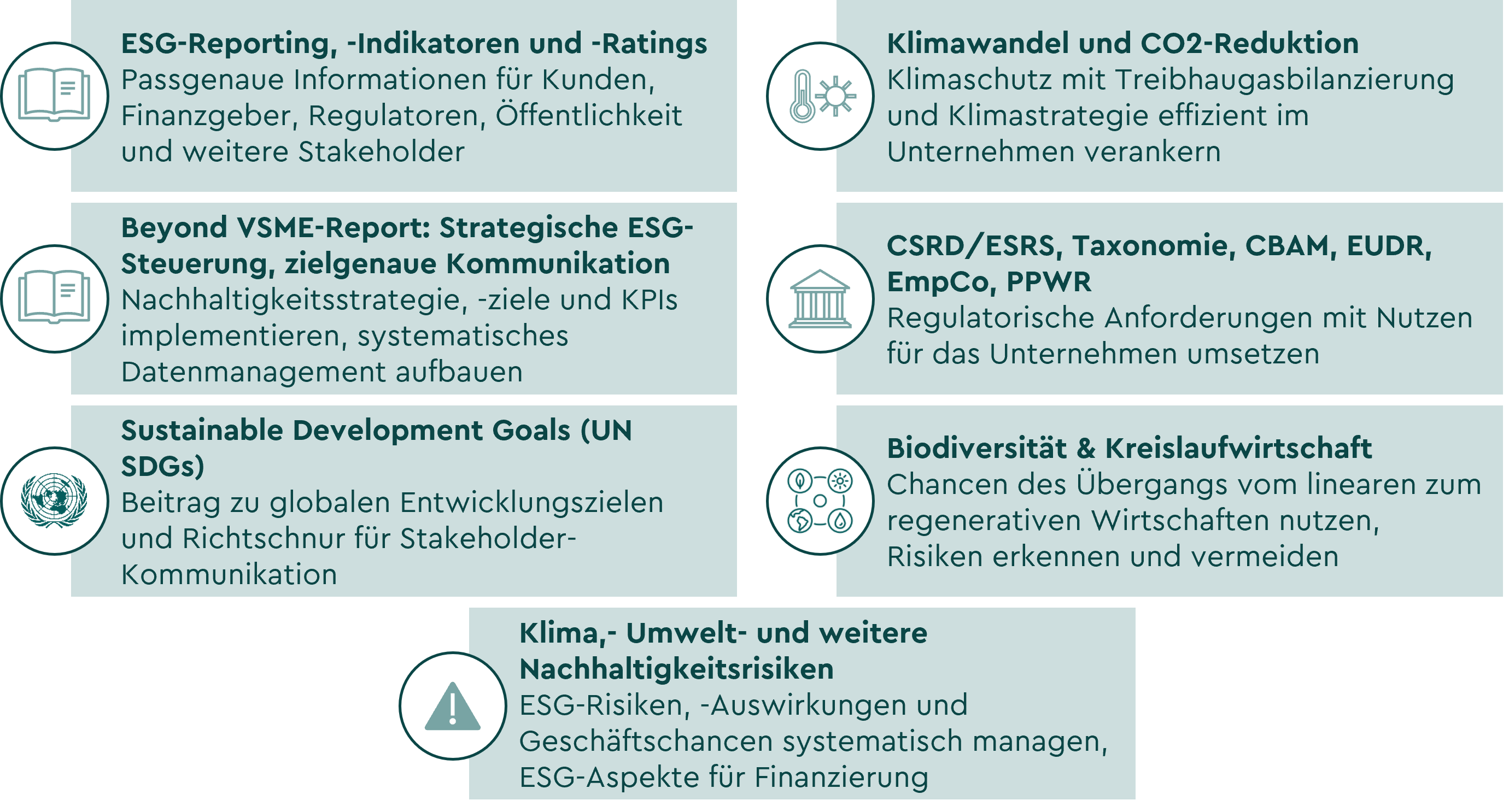
Unsere ESG-Trainings auf einen Blick:
Unsere Leistungen zum DNK für Sie
Sie möchten mit Ihrem Unternehmen eine DNK-Erklärung oder einen Nachhaltigkeitsbericht erstellen, um Ihre Stakeholder und externe Experten über Ihre Maßnahmen zu informieren und sich positiv für die Zukunft aufzustellen? Sie werden berichtspflichtig und möchten sich schon jetzt auf den CSRD vorbereiten?
Als DNK-Schulungspartner unterstützen wir Sie gerne dabei!
Was ist der DNK?
Der Deutsche Nachhaltigkeitskodex (DNK) ist ein Transparenzstandard zur Nachhaltigkeitsberichterstattung und umfasst 20 DNK-Kriterien, die durch nichtfinanzielle Indikatoren aus GRI oder EFFAS ergänzt werden. Außerdem bietet der DNK die Möglichkeit, zum Nationalen Aktionsplan Wirtschaft und Menschenrechte (NAP) – seit 2023 zum Lieferkettensorgfaltspflichtengesetz (LkSG) – sowie der CSR-Berichtspflicht (CSR-RUG) zu berichten. Dabei werden die Themenbereiche Strategie, Prozessmanagement, Umweltbelange, Arbeitnehmerbelange und Gesellschaft sowie Unternehmensführung abgedeckt.
Die Erklärung zum Deutschen Nachhaltigkeitskodex bietet KMU sowie Großunternehmen die Möglichkeit ihre Nachhaltigkeitsstrategie zu kommunizieren, diese weiterzuentwickeln und sich bestmöglich auf ihre Berichtspflicht nach CSRD vorzubereiten.
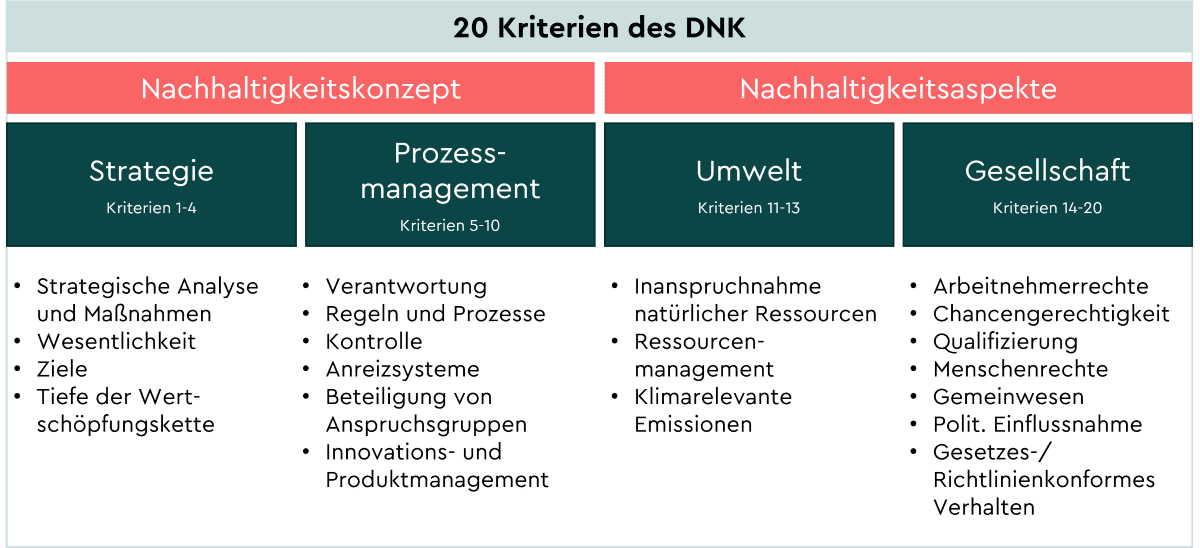
Unsere Leistungen zum DNK für Sie:
- Erhebung relevanter qualitativer und quantitativer Daten
- Analyse von Nachhaltigkeitsrisiken
- Erstellung eines Zeitplans
- Erstellung der DNK-Erklärung in der Datenbank
- Einreichung der Erklärung zur formalen Prüfung und Freigabe
- Einbettung der Erklärung in den Nachhaltigkeitsbericht
Unsere Leistungen zum GRI für Sie
Sie möchten einen Nachhaltigkeitsbericht nach den Standards der Global Reporting Initiative erstellen, um Stakeholder, Rating-Agenturen und externe Experten über die Nachhaltigkeitsziele, Maßnahmen und Kennzahlen Ihres Unternehmens zu informieren?
:response unterstützt Sie gerne während des gesamten Prozesses einer transparenten Berichterstattung!
Was sind die GRI-Standards?
Die Global Reporting Initiative (GRI) Standards sind der international anerkannteste Standard für die Nachhaltigkeitsberichterstattung.
Die freiwilligen Leitlinien bestehen aus allgemeinen „Universal Standards“ – dazu gehören die grundlegenden Berichtsprinzipien, der Wesentlichkeitsprozess sowie allgemeine Angaben zum Unternehmen, zum Berichtsprofil und zur Unternehmensführung – und themenspezifische Standards, die abhängig von ihrer Wesentlichkeit zu berichten sind. Ende 2021 wurden die Universal Standards grundlegend überarbeitet, seit Veröffentlichungsjahr 2023 sind diese anzuwenden. Seitdem sind unter anderem erweiterte Angaben zu Governance und Menschenrechten zu machen und es gibt verpflichtende Sektorstandards.
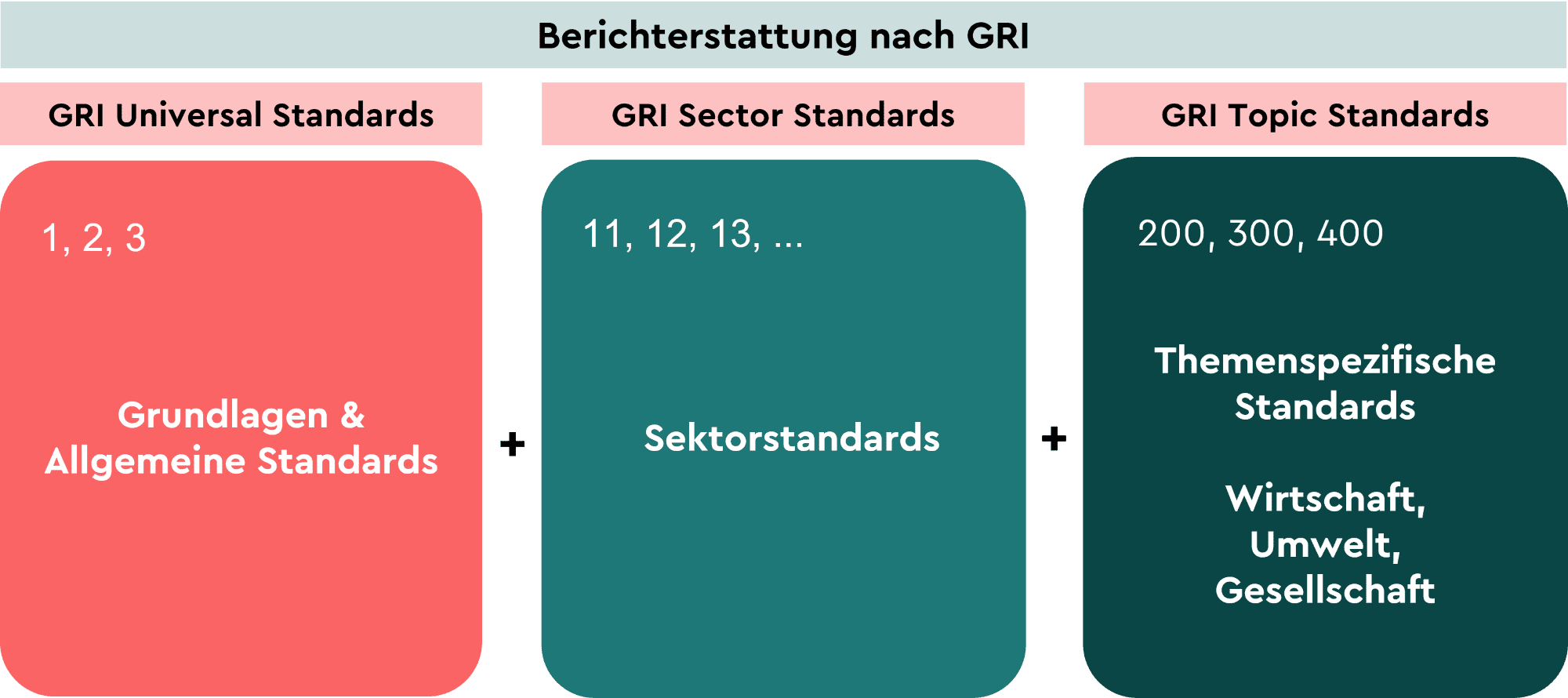
Unsere Leistungen zum GRI-Standard für Sie:
- Umstellung GRI Standards 2016 auf GRI Universal Standards 2021
- Wesentlichkeitsanalyse gemäß GRI und Auswahl der zu berichtenden GRI-Angaben
- Erhebung der qualitativen GRI-Angaben und Kennzahlen
- „GRI-Check“: Review auf Erfüllung der GRI-Anforderungen
- Erstellung des GRI Index
- Beratung bei der Umstellung von GRI auf CSRD/ESRS
Unsere Leistungen zum VSME für Sie
Der Voluntary Sustainability Reporting Standard for non-listed SMEs (VSME) bietet kleinen und mittleren Unternehmen (KMU), die nicht kapitalmarktorientiert sind, eine strukturierte und anerkannte Grundlage zur freiwilligen Nachhaltigkeitsberichterstattung. Dieser Standard hilft KMU, Transparenz über Nachhaltigkeitsthemen zu schaffen, Stakeholder-Anforderungen zu erfüllen und langfristig nachhaltige Unternehmensstrategien zu entwickeln.
Da der VSME im sogenannten SME-CAP-Format (SME Core Assessment Protocol) – einer strukturierten Übersicht der Anforderungen, die große Unternehmen im Rahmen der CSRD an ihre kleinen und mittleren Zulieferer stellen – alle relevanten Informationen enthält, sind Sie mit dem VSME optimal darauf vorbereitet, den Informationsbedarf Ihrer Kunden und Zulieferer zu decken.
:response unterstützt Sie bei der optimalen Implementierung der VSME-Standards – von der passgenauen Definition der Berichtsinhalte über die Integration von Nachhaltigkeitsstrategien und -prozessen bis zur Erstellung eines klaren und standardkonformen Berichts.
Was ist der VSME?
Der Voluntary Sustainability Reporting Standard for non-listed SMEs (VSME) wurde entwickelt, um kleineren und mittleren Unternehmen eine praktikable und standardisierte Möglichkeit zur Nachhaltigkeitsberichterstattung zu bieten.
Anders als die European Sustainability Reporting Standards (ESRS), die für CSRD-pflichtige Unternehmen verpflichtend anzuwenden sind, richtet sich der VSME explizit an nicht kapitalmarktorientierte KMU, die nicht unter die CSRD-Pflicht fallen und freiwillig eine strukturierte Nachhaltigkeitsberichterstattung einführen möchten. Für ambitionierte, CSRD-pflichtige Unternehmen stellt der VSME außerdem eine Möglichkeit dar, noch vor 2028 standardkonform über ihr Nachhaltigkeitsengagement zu berichten.
Der VSME orientiert sich an etablierten Berichtsstandards wie den European Sustainability Reporting Standards (ESRS) und bietet eine angepasste Berichterstattung für KMU, die wesentliche Umwelt-, Sozial- und Governance-Aspekte (ESG) abdeckt. Dies umfasst unter anderem die Darstellung von Klimastrategien, Ressourcennutzung, sozialen Auswirkungen und Unternehmensführung.
Der VSME besteht aus zwei Modulen:
Basis und Umfassend
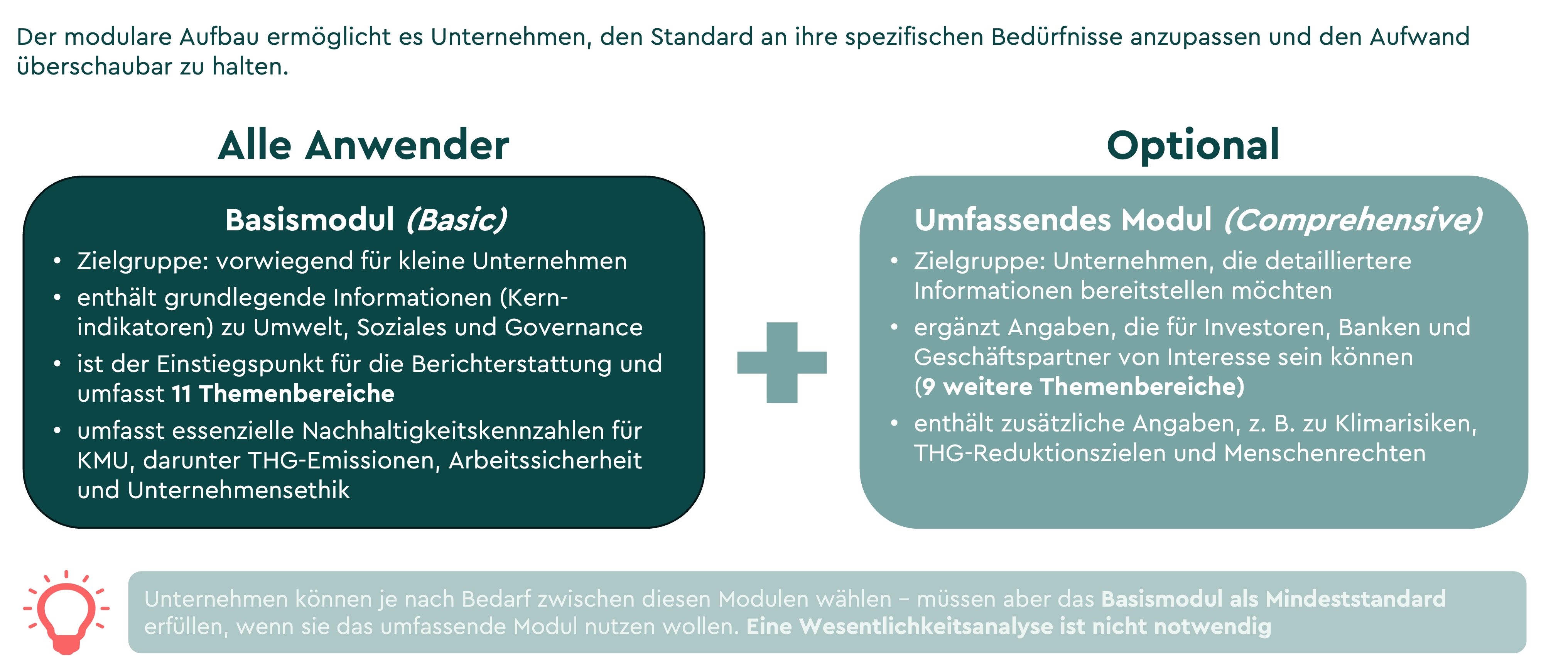
- Basic-Modul: Enthält grundlegende Anforderungen, geeignet insbesondere für Kleinstunternehmen oder KMU mit wenig Ressourcen.
- Comprehensive-Modul: Erweitert das Basic-Modul um vertiefte Angaben, etwa zu Strategien, Zielen, Maßnahmen und Lieferkettenbeziehungen.
Der VSME zeichnet sich zudem durch seine unkomplizierte Anwendung aus: Eine doppelte Wesentlichkeitsanalyse ist, anders bei den ESRS, keine Voraussetzung für Berichterstattung. Durch das „if applicable“-Prinzip können einzelne Angaben ausgelassen werden, sollten sie sich nicht sinnvoll auf Ihr Unternehmen anwenden lassen.
Wer kann vom VSME profitieren?
Der VSME richtet sich insbesondere an:
- Kleine und mittlere Unternehmen (KMU), die Transparenz gegenüber Kunden, Lieferanten und Investoren erhöhen wollen.
- Unternehmen, die Nachhaltigkeitskriterien in ihre strategische Ausrichtung integrieren möchten.
- Lieferanten größerer Unternehmen, die im Rahmen der CSRD-konformen Lieferkettenberichterstattung Nachhaltigkeitsinformationen bereitstellen müssen – dank der Kongruenz des VSME mit dem SME-CAP-Format optimal vorbereitet.
- Firmen, die sich frühzeitig auf zukünftige regulatorische Entwicklungen vorbereiten wollen.
Transparentes Reporting ist eine wichtige Grundlage für die Verbesserung der Unternehmensreputation durch die Kommunikation des eigenen Nachhaltigkeitsengagements. Durch seine Anwenderfreundlichkeit schafft der VSME zudem Vergleichbarkeit. Auf diese Weise versetzen sich Unternehmen mit starker Nachhaltigkeits-Performance in eine optimale Position, um Zugänge zu nachhaltigkeitsorientierten Finanzierungsquellen zu gewinnen.
Unsere Leistungen zum VSME für Sie:
- Beratung bei Modul-Auswahl und Anwendung des „if applicable“-Prinzips
- Effiziente Prozessvorlagen, die an Ihre Unternehmensstruktur angepasst werden kann
- Anwenderfreundliche Templates zur Datenerfassung
- Export des Berichts als maschinenlesbares Dokument
- Hunderte erfolgreiche Reporting-Projekte mit kleinen und mittleren Unternehmen
Unsere Leistungen zur EUDR für Sie
Bringen Sie relevante Rohstoffe wie Holz, Kakao, Kaffee, Soja, Palmöl, Rind oder Kautschuk oder daraus hergestellte Produkte auf dem EU-Markt in Verkehr oder handeln damit? Dann betrifft die neue EU-Verordnung über entwaldungsfreie Lieferketten (EUDR) womöglich auch Ihr Unternehmen.
Ab dem 30. Dezember 2026 müssen Unternehmen nachweisen, dass ihre Produkte nicht zur Entwaldung oder Walddegradierung beitragen und im Einklang mit den relevanten Gesetzen im Ursprungsland hergestellt wurden. Diese Verpflichtung gilt unabhängig von Branche oder Produktart.
Für kleinere Unternehmen gelten teilweise verlängerte Fristen und reduzierte Anforderungen. So beginnt die Sorgfaltspflicht für Kleinst- und kleine Unternehmen erst ab dem 30. Juni 2027.
:response unterstützt Sie umfassend bei der Vorbereitung auf die EUDR – von der Identifikation betroffener Produkte über die Rückverfolgbarkeit bis zur Etablierung effizienter Sorgfaltspflichtprozesse. So schaffen Sie Klarheit, vermeiden Risiken und sichern Ihre Marktzugänge.
Was ist die EUDR?
- entwaldungsfrei sind, das heißt von Flächen stammen, die seit dem 31. Dezember 2020 nicht entwaldet oder in ihrer natürlichen Waldstruktur geschädigt wurden,
- rechtskonform erzeugt wurden (gemäß den Gesetzen im Ursprungsland),
- vollständig rückverfolgbar sind – einschließlich Geokoordinaten der Produktionsflächen.
Kern der Verordnung ist eine verbindliche Sorgfaltspflicht (Due Diligence), die eine Risikoanalyse, ggf. Risikominderungsmaßnahmen und die Abgabe einer elektronischen Sorgfaltspflichterklärung umfasst.
Update: Länder-Benchmarking
Seit Mai 2025 liegt das offizielle Länder-Benchmarking der EU vor. Damit werden Herkunftsländer in drei Risikokategorien eingestuft: niedrig, standard und hoch.
Für Unternehmen bedeutet das: Die Einstufung eines Landes beeinflusst den Umfang der Sorgfaltspflichten in Hinblick auf die Anforderungen an die Risikobewertung und -minderung.
Wichtig: Auch bei niedrigem Risiko bleiben die Informations- und Nachweispflichten vollständig bestehen. Unternehmen müssen jederzeit belegen können, woher ein Produkt stammt. Dies schließt die Sammlung von Informationen gemäß Artikel 9 sowie die Dokumentation mit ein.
Das Benchmarking schafft Spielräume, ersetzt jedoch keine saubere Prozess- und Datenbasis. Frühzeitiges Handeln zahlt sich aus.
Wer ist betroffen?

Unsere Leistungen zur EUDR für Sie:
- Einordnung und Betroffenheitsanalyse: Bestimmung der EUDR-relevanten Erzeugnisse und Lieferanten, Ableitung der Rolle und entsprechender Pflichten, Identifikation relevanter Fachabteilungen und Entwicklung von unternehmensweiten Governance-Strukturen
- Aufbau von Datenstrukturen: Identifikation der Datenanforderungen zur Abgabe einer Sorgfaltserklärung, Bewertung bestehender Due Diligence Systeme in Hinblick auf die Anforderungen der EUDR, Entwicklung und Durchführung von Lieferantenabfragen, Aufbau von Prozessen zur Bewertung von Entwaldungs- und Legalitätsrisiken in Herkunftsländern
- Schulungen und Sensibilisierung von internen Stakeholdern, Erstellung interner Leitfäden, Entwicklung von Kommunikationsstrategien und -vorlagen für externe Partner (Lieferanten und Kunden)
- Strategieberatung: Bewertung der Anforderungen der EUDR im Kontext bestehender Beschaffungsstrategien, Ableitung von Maßnahmen zur Risikominimierung, Kontextualisierung im Rahmen von ESG-, CSRD- oder Lieferkettenstrategien
- Berichterstellung und Dokumentation
- Automatisierung: Unterstützung bei der Auswahl geeigneter Software-Anbieter
Unsere Leistungen zur PPWR für Sie
Bringen Sie Verpackungen, verpackte Produkte oder Eigenmarken in der EU in Verkehr? Produzieren, importieren oder vertreiben Sie Waren in Verpackungen? Dann betrifft die neue EU-Verordnung über Verpackungen und Verpackungsabfälle (PPWR) womöglich auch Ihr Unternehmen. Branche oder Unternehmensgröße sind nicht ausschlaggebend. Entscheidend ist die konkrete Rolle pro Verpackungseinheit – diese kann je nach Geschäftsmodell variieren.
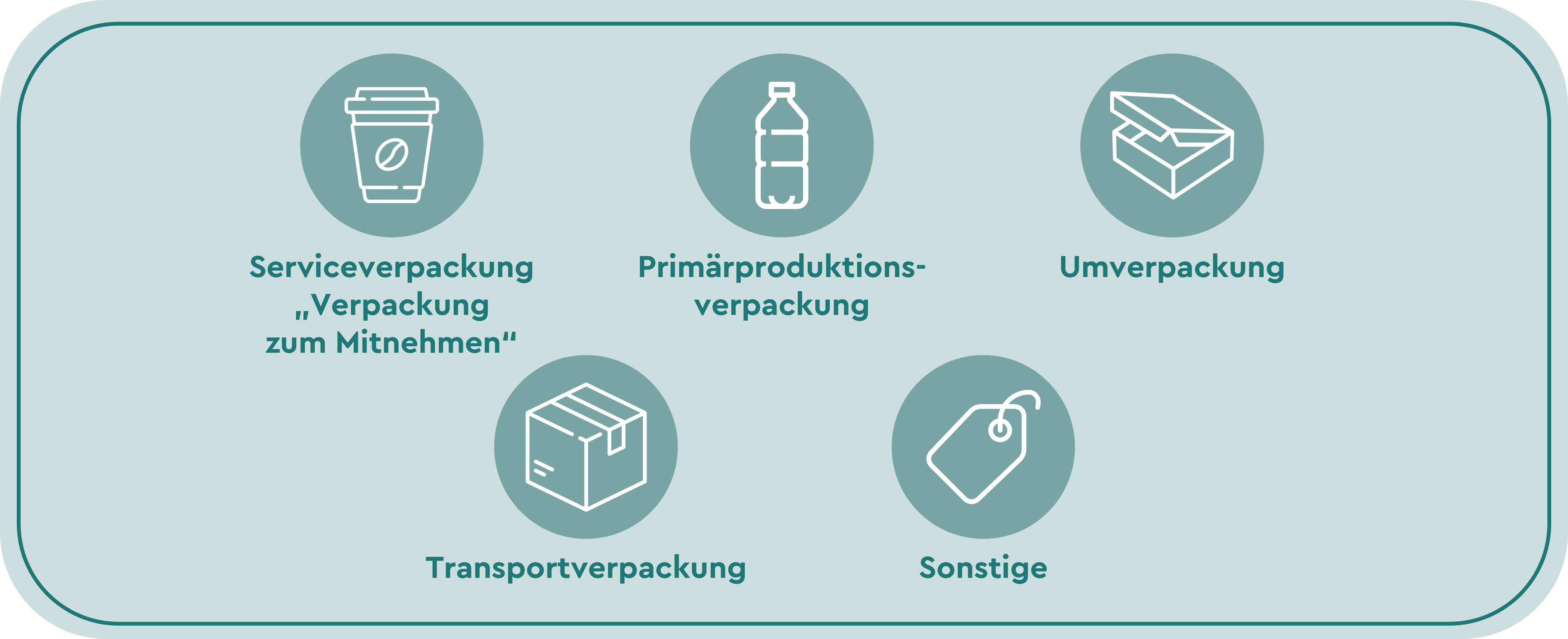
Neben konkreten Anforderungen der PPWR an Verpackungen – etwa zur Recyclingfähigkeit, zu Rezyklatanteilen oder zur Minimierung – stehen insbesondere Transparenz, Dokumentationspflichten und belastbare Daten entlang der Lieferkette im Fokus. Verpackung wird damit nicht nur ein Design- oder Einkaufsthema, sondern ein Compliance- und Datenthema.
:response unterstützt Sie umfassend bei der Vorbereitung auf die PPWR – von der Einordnung Ihrer Rolle als Wirtschaftsakteur, über die systematische Verpackungsanalyse bis zur Implementierung praktikabler Daten- und Umsetzungsprozesse.
Was ist die PPWR?
Die PPWR ist bereits am 11. Februar 2025 in Kraft getreten und gilt erstmals ab dem 12. August 2026 verbindlich. Die Verordnung ersetzt damit die bisherige Richtlinie 94/62/EG und harmonisiert das europäische Verpackungsrecht unmittelbar in allen Mitgliedstaaten.
Sie verändert das Verpackungsmanagement grundlegend: Unternehmen müssen künftig umfangreiche Anforderungen an Design-for-Recycling, Rezyklatanteile, Kennzeichnung, Dokumentation und Datenverfügbarkeit erfüllen.
Unsere Unterstützung für die Umsetzung Ihrer PPWR-Anforderungen
Wir übersetzen Regulierung in praktikable Schritte und denken PPWR ganzheitlich – von der regulatorischen Einordnung über Daten- und Softwarelösungen bis zur koordinierten Umsetzung technischer Anpassungen.
Einordnung & Rollenklärung
- Analyse Ihrer Lieferketten- und Inverkehrbringungsszenarien
- Klärung Ihrer Rolle(n) als Wirtschaftsakteur je Verpackungseinheit
- Ableitung konkreter Pflichten
Verpackungsinventur & GAP-Analyse
- Systematische Erfassung und Klassifizierung Ihrer Verpackungen
- Bewertung des Status quo gegenüber den PPWR-Anforderungen
- Entwicklung einer strukturierten Roadmap
Datenmanagement, Software & Dokumentation
- Definition der erforderlichen Datenstrukturen
- Begleitung bei Auswahl geeigneter Softwarelösungen, Unterstützung bei Implementierung und Prozessintegration
- Einbindung von Lieferanten über geeignete Datenabfragen oder Portallösungen
- Erstellung technischer Dokumentation und EU-Konformitätserklärung
Designanforderungen & Umsetzung
- Einordnung der Design-for-Recycling-Anforderungen
- Koordination von Anpassungen in Zusammenarbeit mit spezialisierten Partnern aus Forschung & Entwicklung
Unsere Leistungen zum Biodiversitätsmanagement für Sie
Abhängigkeiten verstehen, Risiken minimieren und Chancen nutzen
Die biologische Vielfalt ist das Netz des Lebens: Sie ermöglicht fruchtbare Böden, sauberes Wasser, ein stabiles Klima und die Bereitstellung natürlicher Ressourcen. Intakte, widerstandsfähige Ökosysteme sichern damit unsere Lebensgrundlagen und bilden zugleich die Basis einer stabilen Wirtschaft.
Mehr als die Hälfte der globalen Wirtschaftsleistung ist – je nach Branche – moderat bis stark auf funktionierende Ökosysteme angewiesen. Gleichzeitig ist jedes Unternehmen in irgendeiner Form von Biodiversität abhängig – direkt oder indirekt und in unterschiedlichem Ausmaß. Biodiversität ist damit kein Randthema des Umweltschutzes, sondern ein strategischer Faktor für Resilienz, Innovationsfähigkeit und Zukunftssicherheit von Unternehmen.
Dennoch schreitet der Verlust der Biodiversität weltweit voran und wirkt sich zunehmend auf Lieferketten, Standorte und Geschäftsmodelle aus. Unternehmen, die naturbezogene Abhängigkeiten und Risiken frühzeitig analysieren und steuern, erhöhen ihre Planungssicherheit, verbessern ihr Risikomanagement und sichern sich langfristig Wettbewerbsvorteile.
Was bedeutet Biodiversität?
Biodiversität beschreibt die Vielfalt des Lebens auf der Erde. Sie umfasst drei Ebenen:

Eine hohe biologische Vielfalt stärkt die Stabilität und Anpassungsfähigkeit von Ökosystemen. Sie sorgt dafür, dass ökologische Prozesse funktionieren und wichtige Ökosystemleistungen langfristig erhalten bleiben.
Warum ist Biodiversität für Unternehmen relevant?
Unternehmen sind in vielfältiger Weise von funktionierenden Ökosystemen abhängig, teilweise entlang ihrer gesamten Wertschöpfungskette.
- Abhängigkeiten bestehen beispielsweise durch:
- Rohstoffe und landwirtschaftliche Erzeugnisse
- Wasserverfügbarkeit und -qualität
- Bodenfruchtbarkeit
- Bestäubungsleistungen
- Klimaregulation
- Resiliente Lieferketten
- Stabile Standortbedingungen
Neben physischen Risiken durch den Biodiversitätsverlust entstehen für Unternehmen auch Übergangsrisiken durch regulatorische Anforderungen, Marktveränderungen und steigende Erwartungen von Investoren, Kunden und Finanzinstituten.
Eine systematische Analyse naturbezogener Abhängigkeiten und Auswirkungen bildet die Grundlage, um Risiken zu verstehen, Prioritäten zu setzen und gezielte Maßnahmen im Unternehmen zu entwickeln.
Unsere Leistungen im Biodiversitätsmanagement
:response begleitet Sie systematisch bei der Integration von Biodiversität in Ihre Nachhaltigkeits- und Unternehmensstrategie: von der Analyse bis zur Umsetzung und Berichterstattung.
Mapping Ihres Biodiversitätsprofils
- Standortbezogene Risikoanalyse
- Identifikation wesentlicher Abhängigkeiten und Auswirkungen im eigenen Betrieb und entlang der gesamten Wertschöpfungskette
Digitale Analyse- und Bewertungsinstrumente
- Einführung von Geodaten- und KI-gestützten Tools
- Bewertung von naturbezogenen Risiken und Compliance-Anforderungen
Zieldefinition und strategische Verankerung
- Entwicklung von Biodiversitätszielen
- Integration von Science Based Targets for Nature (SBTN)
- Verankerung in bestehende ESG- und Nachhaltigkeitsstrategien
Maßnahmenentwicklung und Integration
- Definition von Vermeidungs-, Minderungs- und Anpassungsmaßnahmen
- Entwicklung von Transitionsplänen
- Integration in Managementsysteme und bestehende Prozesse
Regulatorische Umsetzung und Reporting
- Unterstützung bei CSRD-, VSME-, EU-Taxonomie- und SFDR-Anforderungen im Bereich Biodiversität
- Berichterstattung gemäß Taskforce on Nature-related Financial Disclosures (TNFD)
- Aufbau eines belastbaren Datenmanagements
Ihr Mehrwert
Ein strukturiertes Biodiversitätsmanagement schafft:
- Transparenz über naturbezogene Risiken und Abhängigkeiten
- Erhöhte Resilienz von Lieferketten und Standorten
- Sicherheit im Umgang mit regulatorischen Anforderungen
- Glaubwürdigkeit gegenüber Investoren und Stakeholdern
- Strategische Wettbewerbsvorteile in einem sich wandelnden Marktumfeld
Biodiversität ist ein zentraler Zukunftsfaktor für nachhaltiges Wirtschaften.
:response unterstützt Sie dabei, naturbezogene Risiken frühzeitig zu erkennen, regulatorische Anforderungen effizient zu erfüllen und Biodiversität strategisch in Ihre Unternehmensentwicklung zu integrieren.
Diese Dekade ist die des Handelns.
Unternehmen werden einen entscheidenden Beitrag leisten.
:response

Strategie
Unternehmensstrategie
und Nachhaltigkeit verbinden
Die Entwicklung einer nachhaltigen Unternehmensstrategie ist eine entscheidende Komponente unserer Beratungsleistung. Hier geht es darum, ob sich die Organisation auf das Richtige – das Wesentliche – fokussiert und zugleich Nachhaltigkeit ganzheitlich integriert. Denn Nachhaltigkeit lässt sich steuern – wenn man Wirkungen messbar macht und Ziele definiert. :response entwickelt für Ihr Unternehmen Managementansätze und bestimmt Fortschrittsindikatoren auf Basis bewährter Standards (Global Reporting Initiative, Deutscher Nachhaltigkeitskodex, ISO 26000).
Vielen Unternehmen und Organisationen fehlt es nicht an Ideen: Die Herausforderung ist die Umsetzung – als strategische Initiative oder als leistungsfähige Organisationseinheit Veränderungsprozesse durchzuführen. Eine gute Strategie wird verstanden und gelebt: Wir helfen Ihnen dabei, eine überzeugende Strategie zu entwickeln.
Dazu gehören Analysen, Evaluation und Impact Measurement, um die Basis für eine strategische Unternehmensführung zu schaffen. Durch innovative Methoden wie Design-Thinking und Theory U unterstützen wir Sie und Ihr Team dabei, bei der Lösungsfindung neue Wege einzuschlagen.
Nachhaltigkeit, die bleibt.
:response

Management
Nachhaltigkeit leben, Menschen stärken
Nachhaltigkeit gestalten und leben
Eine gute Strategie wird erst mit der wirkungsvollen Umsetzung komplett. Wir halten die Umsetzung für eine entscheidende Komponente der Strategie. Hier zeigt sich, was wirkt. Führende Manager haben in den letzten Jahren darüber nachgedacht, wie sie ihre Organisationen schneller und effektiver in Richtung Nachhaltigkeit bewegen können. Vielen von ihnen konnten wir mit unserer Expertise zur Seite stehen.
Wir bauen mit Ihnen eine schlanke Managementstruktur auf, setzen Ihre Ziele um und überprüfen die KPIs. Wir unterstützen Sie bei der Datenerhebung und der Aufbereitung Ihrer Kennzahlen. So können Sie überprüfen, ob Ihre Strategie auch in der Umsetzung wirksam ist.
Menschen und Organisationen stärken
Organisationen sind erfolgreich, wenn Strategie, Struktur und Kultur gut ineinandergreifen und den Menschen die Möglichkeit geben, diese durch Partizipation mitzugestalten. Transformation bedeutet Veränderung. Wir begleiten Sie dabei, Ihre Organisation zu einem nachhaltigen, gesunden und innovativen Unternehmen voranzutreiben und auch mit begrenzten Ressourcen große Wirkung zu erzielen.
Wir entwickeln Management-Teams und Führungskräfte in den Themenfeldern Leadership, Nachhaltigkeit und CSR.
Wir gestalten herausragende Kommunikation – in einer Zeit, in der alle nachhaltig sein wollen!
:response

Kommunikation
Profitieren aus enger Zusammenarbeit
Kommunikation schafft Transparenz und Vertrauen
Die Nachhaltigkeitsstrategie eines Unternehmens wirkt nicht ohne Kommunikation und Dialog. In den letzten Jahren haben sich die Anforderungen massiv verändert. Höhere Standards, mehr Transparenz, mehr Perspektiven und mehr Verlässlichkeit gehören dazu. Auch die Ansprüche von Stakeholdern und Mitarbeiterinnen und Mitarbeitern sind gestiegen. Kommunikation ist heute nur zielführend, wenn sie glaubwürdig ist und zum Handeln motiviert.
Beteiligung und Stakeholder-Dialoge
:response hat aus langjähriger Erfahrung ein Konzept für wirksame Partizipation entwickelt. Erfolg verstehen wir dabei als Mehrwert für alle Beteiligten und die Organisation, die zur Beteiligung einlädt (Shared Value). Entscheidend für eine wirksame Umsetzung sind das Zusammenbringen der richtigen Personen, die gekonnte Durchführung und die sorgfältige Verwertung der Ergebnisse.
Nachhaltigkeitsberichte und -kommunikation
Verbraucher, Mitarbeitende, Kunden aber auch Investoren wollen wissen, wie Unternehmen ihre ökonomische, ökologische und gesellschaftliche Verantwortung umsetzen. Dabei bieten wir vom Nachhaltigkeitsbericht nach CSRD, VSME, GRI und DNK, dem integrierten Nachhaltigkeitsbericht bis hin zur digitalen Berichterstattung alles, was unsere Kunden benötigen.
Haben Sie Fragen zu unseren Leistungen?
Jederzeit gerne.