
Identifying climate risks. Strengthening resilience.
Climate risks are no longer just a future concern; they are already having a very real impact on businesses today. Extreme weather events, rising temperatures and changing rainfall patterns are affecting sites, supply chains and production processes. At the same time, regulatory requirements, technological developments and changing market demands are giving rise to new economic risks and opportunities.
A systematic climate risk assessment creates transparency regarding these impacts and forms the basis for well-informed business decisions. It helps companies to identify and assess climate-related risks at an early stage and to develop appropriate adaptation measures.
Whether as part of sustainability reporting under the CSRD, within the framework of the EU Taxonomy, or as a tool for forward-looking risk management – :response supports you from the analysis stage right through to the implementation of appropriate measures.
What is a climate risk assessment?
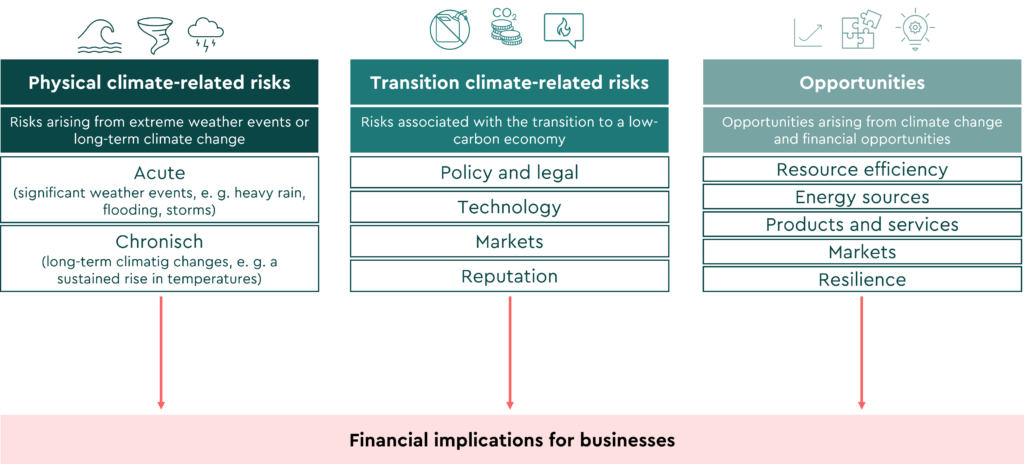
A climate risk assessment analyzes the potential impacts of climate change on your business. It considers both physical risks and transitional risks.
Physical risks arise from the direct consequences of climate change, such as heavy rainfall, flooding, heatwaves or storms. They can damage sites, disrupt production processes or interrupt supply chains.
In order to identify and quantify physical climate risks on a site-specific basis, we carry out a software-based assessment that utilizes recognized climate scenarios (e.g. IPCC) and is based on science-based models. We are happy to assist you in selecting suitable software, drawing on our many years of experience. We always operate independently of any particular manufacturer.
Transitional risks arise from the transition to a climate-neutral economy. These include, amongst other things, regulatory requirements, rising CO₂ costs, technological changes and shifting expectations from customers, investors or financial institutions.
The assessment of transition risks is based on recognized climate scenarios (e. g. IEA; NGFS) and considers short-, medium- and long-term developments. This provides a robust understanding of which business areas, sites or stages of the value chain are particularly affected and where action is required.
Why is a climate risk assessment important?
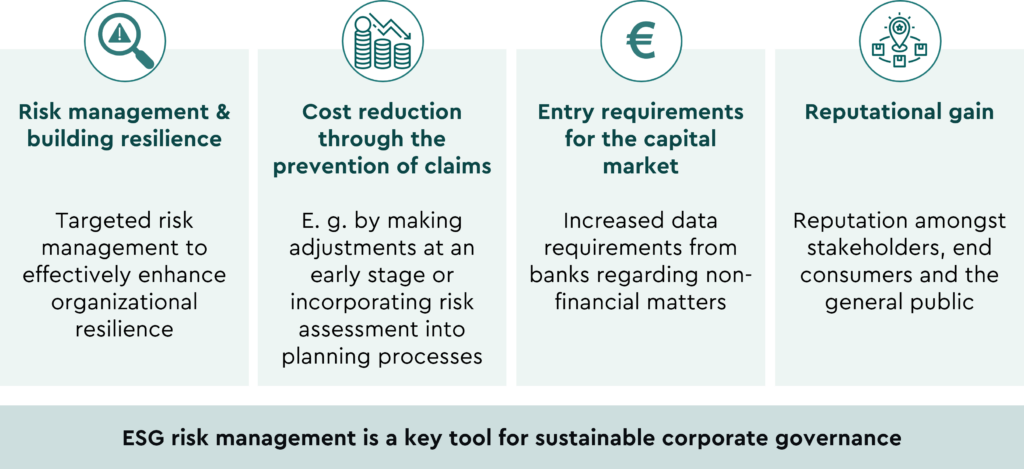
Companies are under increasing pressure to address climate risks. A thorough climate risk assessment helps you to
• identify climate-related risks and opportunities at an early stage,
• identify the locations, supply chains and business processes most affected, and to reduce the resulting costs,
• prioritize adaptation measures in a targeted manner,
• make more informed investment and location decisions,
• meet the requirements of investors, banks and business partners, and
• implement regulatory requirements under the CSRD, the EU Taxonomy or IFRS S2.
Our climate risk assessment services:
• Analysis of physical and transitional climate risks as well as climate-related opportunities in accordance with the CSRD, the EU Taxonomy and/or IFRS S2, based on recognized climate scenarios
• Analysis of sites, business processes and value chains with regard to their climate exposure
• Visualization and prioritization of material short-, medium- and long-term climate risks
• Development of suitable adaptation measures to strengthen corporate resilience
• Integration of the results into existing risk management processes
• Preparation of audit-ready documentation and support with reporting in accordance with the CSRD, the EU Taxonomy, the TCFD and/or IFRS S2.
Contact Us
We are here to answer your questions. Together with our customers, we create an environment in which people enjoy getting involved. We create value for people, organisations and society.


