
EmpCo Directive: Review sustainability communications. Reduce risks. Strengthen credibility.
With the Empowering Consumers Directive – EmpCo for short – the European Union is tightening the requirements for environmental and sustainability claims made to consumers. Terms such as ‘environmentally friendly’, ‘climate-neutral’ or ‘sustainable’ must not, in future, be used in a generalised, unsubstantiated or misleading manner.
The new regulations will come into force in Germany on 27 September 2026. Companies should therefore review their websites, packaging, product descriptions, campaigns and other communication materials aimed at end customers at an early stage.
:response supports you in further developing your sustainability communication in a way that is factually sound, transparent and credible. We identify potential EmpCo risks, organise supporting evidence and develop expert recommendations on wording and processes.
What is the EmpCo Directive?
Directive (EU) 2024/825 on empowering consumers for the green transition is intended to better protect consumers from greenwashing and other unfair commercial practices. In Germany, the requirements are enshrined in particular in the Act against Unfair Competition (UWG).
This applies to voluntary environmental and sustainability claims made in consumer communications – for example, on websites, in online shops, on social media, in brochures, in product names or on packaging.
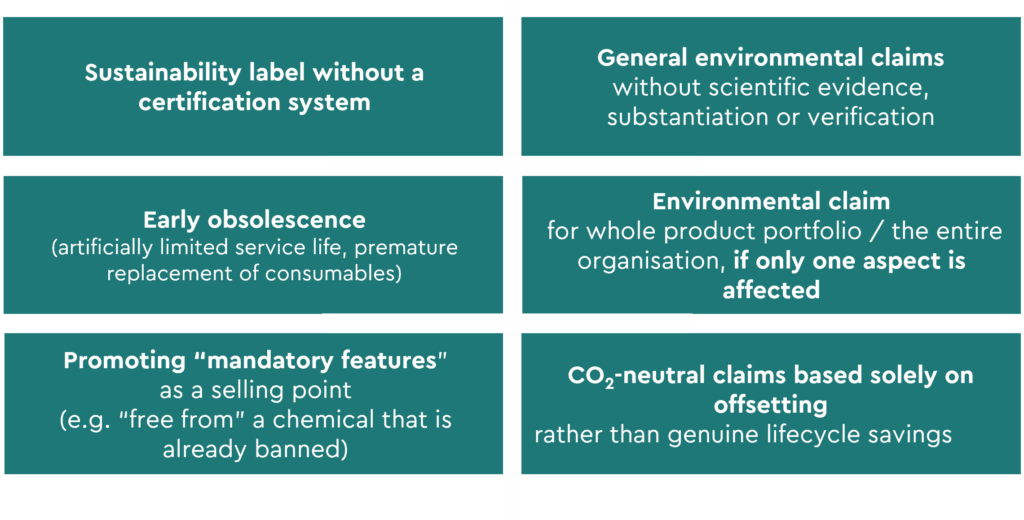
The following requirements are particularly relevant:
Why is the EmpCo relevant for organizations?
The EmpCo Directive concerns voluntary environmental and sustainability claims made to consumers – ranging from websites, online shops and packaging to campaigns, labels, product and brand names, and visual representations. Companies should therefore systematically record their claims, clearly define their scope and substantiate them with appropriate evidence.
This requires close coordination between marketing, sales, product management and sustainability management; legal interpretation and approval issues should be overseen by the relevant legal department.
Preparing at an early stage will help you to
• reduce legal and reputational risks,
• identify problematic statements in good time,
• build robst evidence of environmental or social performance,
• establish clear review and approval processes, and
• continue to communicate credibly on sustainability.
Our EmpCo services for you:
• Technical screening (EmpCo-Check) of your communication materials and support in developing technically accurate, transparent and audience-appropriate wording suggestions
• Support in developing detailed and realistic implementation plans for future environmental performance targets
• Technical review and regular monitoring of detailed implementation plans for communicated future environmental performance targets
• Practical training for relevant specialist departments with an industry and communications focus
• Identification of data gaps and design of robust evidence structures for claims made – compatible with greenhouse gas inventories, climate transition plans or your existing ESG reporting
We support companies in their technical preparation for the EmpCo requirements and in the further development of their environmental and sustainability communication. In doing so, we combine claim screening, verification logic, data management and practical communication processes. Our consultancy does not include case-by-case legal reviews or legal approval.
Contact Us
Our mission is to answer your questions. Together with our clients, we create an environment in which people are keen to get involved. We create value for people, organisations and society.


